Showing posts with label Thanksgiving. Show all posts

Monday, October 6, 2025

Looking Ahead to October 12, 2025 -- Thanksgiving Sunday


The Scripture Readings this week are:

  • Psalm 100
  • Deuteronomy 26:1-11

The Sermon title is Thankful Remembering, Thankful Giving


Early Thoughts:
DO you pause to remember? Do you pause to recall what God has done? What happens when you do that?

This passage from Deuteronomy describes a ritual of presenting a thank-offering. It describes it as one of the first things you do at harvest (I wonder if first fruits means every year or just the first harvest in this context?) You take a portion and offer it to God. As you do that you name those things that God has done for you and for the people and out of thankfulness you give to God as you celebrate the abundance of the land.

So what do we do with this story?  We have not just entered the Promised Land. Many of us do not have fields to harvest and bring in the first fruits. Few of us have a story of how our recent ancestors were delivered from an oppressive empire (at least not as specifically as the Exodus story). The story can't be talking about how we are to act -- can it?

It is my contention that we read these ancient stories because even if our context and lives are very different from the culture that passed them on to us they do have something to teach us about how we are called to live.

In this case the story has much to tell us.  There are three parts to the ritual that is described: offering, remembering/recalling/retelling, and celebrating.

How do we incorporate all three into our lives?

It is my firm belief that the act of remembering with thankfulness how we have benefited for the gifts we have been given changes our hearts and minds. When we intentionally pause to name those gifts, to retell the story, to celebrate the abundance we are more open to do the offering. A thankful heart is most often a generous heart.

AS we move into Thanksgiving weekend this year I encourage us all to remember. As we remember I encourage us to tell stories, talk about the gifts we have received. Then celebrate them. Be glad for the gifts, even sing  if you are so minded. Then open yourself to the next step -- sharing, making an offering. I want us to ask ourselves what 'first fruits' we might have to lay down before God, not just on Thanksgiving or in some sort of ritual but on a day-to-day basis. As I said above, we will be more open to identifying what we can share if our hearts are filled with a sense of abundance and a feeling of thankfulness.

When we forget to remember, when we don't tell ourselves the stories of gifts received we can more easily fall prey to the ongoing claxon telling us there is not enough. We miss the abundance. Worry or jealousy take the place of gratitude. In that place there is little celebrating, little impulse to be generous.

THe choice, in the end, is ours. What will we choose to remember? What will we choose to see? Will we be generous and thankful?
--Gord

Monday, October 7, 2024

Looking Ahead to October 13, 2024 -- Thanksgiving Sunday

The Scripture Readings this week are:

  • Joel 2:21-27
  • Matthew 6:25-33

The Sermon title is Share Thanks, Not Worries

Source
Early Thoughts: There are a number of lists of failed church signs/announcements circulating around the internet (and have been for decades, well before social media took over the world). One of those failed messages is shown in the picture. It could be a great statement about faith helping us deal/cope with worry--or it could be a much more negative comment.

Some of us are natural-born worriers.  Worry is a default reaction for some of us -- we are always wondering what could/will go wrong or how this could end badly. For others worry is a reality of life because no matter how they do the math there just isn't 'enough'.

Quite often I read this passage from Matthew with at least half my mind saying that Jesus is not being reasonable or realistic. Then again I am one of those natural worriers. Still, telling people not to worry about where their next meal will come form but to live on trust seems a bit utopian to me. Maybe I am being a bit too literal, a bit too all or none in my thinking?

What happens when we dwell on our worries and anxieties? Does it, as Jesus reasonably asks, "add a single hour to the span of your life"? One could (and many have) in fact argue that dwelling on our worries and anxieties and fears can shorten our lives, while simultaneously robbing us of happiness.

What might happen if we dwell on the reasons we have to be thankful? What happens if we choose to highlight the ways God has been with us, bringing hope instead of despair, abundance where we only saw scarcity, renewal where we only see destruction, life instead of death? It might not add a single hour to the span of our lives, or it might by lowering our blood pressure and saving us from cortisol poisoning, but it almost certainly would add happiness to those days. It might also make us easier/more pleasant to be around.

Many years ago Bobby McFerrin urged us all to Don't Worry, Be Happy. A bouncy little song, it lifts my spirits just to listen to it but when you look at the lyrics you see that it has a degree of realism. Unlike Pharrell's song Happy from a decade ago, which is just about being happy all the time, McFerrin's lyrics name several reasons one might have worries that weigh them down. Still he encourages us to put those worries aside, to not let them run our lives.

This, I think is a path to better mental emotional health (or at least part of the path). We need to be honest and realistic about life but then we need to make a choice. We can choose to focus on our worries and anxieties. Or we can choose to focus on the good things and give thanks with a grateful heart.

When I talk about this month being a Month Of Thanks or call it Thanktober I am encouraging us to make the second choice. Joel shares a promise to a people who have had a hard time of it, a promise that God will reverse their fortunes. Jesus tells his followers to live lives based on trust and hope rather than worry and anxiety. Let's all try to share our thanks more than our worries. It will, I believe, make us happier as individuals and as a community. It also appears to be how God would have us live.
--Gord

Monday, October 2, 2023

Looking Ahead to October 8, 2023 -- Thanksgiving Sunday


The Scripture Readings this week are:

  • Deuteronomy 8:7-18 
  • 2 Corinthians 9:6-15

The Sermon title is Why Are You Thankful?

Early Thoughts: Gratitude is like a muscle. It gets stronger with exercise. I suspect, in fact I firmly believe, that Gratitude also feeds Generosity.

There is a myth in North American culture (perhaps more prevalent in the US, but also in Canada), the myth of the "self-made man" (and in the myth it is almost always referred to in male terms). When we challenge that myth we may get push back. I remember in the 2012 US Election when President Obama pushed back at the idea that anyone got where they were without support from the community (because the community built roads and systems and infrastructure) by saying "You didn't build that". Some people found that a horrible thing to say, some of us saw it as a very accurate statement. In this passage Moses, knowing that people have poor memories or see history in different ways at times, pushes people to remember that they got where they were because God was with them.

This reading from Deuteronomy reminds us that one of the first steps in gratitude, in being thankful, is to remember. We are thankful when we remember that we are the recipients of gifts. We are thankful (or are more likely to be thankful) when we remember that we did not get what we have all by ourselves.

So what gifts have changed your life? Why do you give thanks this year? Look beyond the obvious, easy answers. I encourage all of us to look at various parts of our lives and find the more hidden gifts, the more hidden reasons we are thankful.

There are practices of life that have a transformative effect. Gratitude/Thanksgiving is such a thing. The more we recognize that we have to be thankful for, the more we share our words of gratitude and thanksgiving the more we are changed. When we recognize that we have been gifted, we are more likely to share those gifts with the world around us. We are more likely to do that sharing cheerfully and freely rather than as a task that we 'ought' to do. And then that sharing has the potential to be transformative in the world, which leads to more sharing, which lead to more transformation... and so on.

It is Thanksgiving weekend. Of course we are called to be thankful all year round, however this is the weekend when we are perhaps a little bit more intentional about it. Let us take time to reflect on the gifts we have received. Let us take time to reflect on how our gratitude gets shown in the way we live our lives. Let us, knowing the we have been given gifts, pledge to pass that giftedness on to the world around us. Let us all be both Grateful and Generous.
--Gord

Monday, October 3, 2022

Looking Ahead to October 9, 2022 -- Thanksgiving Sunday

The Scripture Readings this week are:


  • Deuteronomy 26:1-11
  • Philippians 4:4-9
  • John 6:25-35

The Sermon title is Remember with Thanks

Our Tree of Thanks waiting for more leaves


Early Thoughts:
For what are you thankful this year?  As we approach Thanksgiving weekend we are encouraged to think about the gifts we have received over the past year (and the years before that). Sometimes we forget to be thankful. Sometimes we forget what we have to be thankful for. In a world where there is an entire, multi-BILLION dollar industry dedicated to convincing us to buy more it can be easy to forget about the abundance we already have.

This passage from Deuteronomy, a common one for Thanksgiving Sunday, is not really about giving thanks -- at least not at first reading.  It is about remembering. And it is about giving from what you have.

The remembering what God has done is a common theme in the stories of the Israelite people. Does that mean they tended to forget to remember? Remembering is often a conscious act, it is something we choose to do (or choose not to do). But if we don't remember what happens?

I am not thinking here of Santayana's dictum that those who forget their history are doomed to repeat it (though I tend to find wisdom there). I am thinking of how remembering or forgetting tie in to both our gratitude and our stewardship.

If we forget then are we aware of why we are grateful? I suspect not. If we forget the path that has led us to this point, the gifts shared and given to help us along the way, then it is easy to not express our gratitude.

If we forget the gifts shared and given that helped us along the path it is easier to think that we did it all by ourselves. And then to wonder why others can not do the same for themselves.

Memory is at the base of our gratitude and our stewardship. In the Deuteronomy passage the act of remembering is intrinsically tied to the act of offering the first-fruits to God's service. Practically speaking it appears that this offering goes to feed an support the Levites (religious workers) and Priests as well as those who are in need. As they remember they are thankful and they give from what they have received.

What memories make you thankful? What gifts do you pass forward as you remember and are grateful
--Gord

Monday, October 4, 2021

Looking Ahead to October 10, 2021 -- Thanksgiving Sunday


 The Scripture Readings this week are:

  • Psalm 126
  • Matthew 6:19-34

The Sermon title is What, Me Worry?

Early Thoughts: I am a worrier. I have been a worrier for as long as I can remember. I can always find something to worry about in any situation. I might call it my superpower except...well it doesn't seem like much of a power.

So what do I do with a Jesus who tells me not to worry?

Certainly I have been blessed enough that my worries have never been about where my next meal will come from, or next month's rent, or having nothing to wear. But still I am a worrier. I can always see the worst possible outcome (even if I know that said outcome is not very likely) and worry about it. While I can often make myself see the positive possibilities I naturally find the catastrophic possibilities.

So what do I do with a Jesus who tells me not to worry?

This is a bit of an odd choice for Thanksgiving. Thanksgiving is a time to celebrate the gifts we have been given. Thanksgiving is a time to celebrate that harvest has been safely gathered in (and with a mix of rain and snow in the forecast for this week I do hope many of the fields have been taken in by now). Why would we talk about worries? The Psalm reading makes much more sense for Thanksgiving than a passage with warnings about storing up treasures, and watching where our heart lies, and worrying too much. [As a side note, on this week when we read the psalm which includes verse 6 about coming home joyfully carrying the sheaves we are indeed going to sing Bringing in the Sheaves]

Then again, what keeps us from being thankful? One thing is when we are feeling threatened, that we don't have enough, that we are not safe, that we have to store us extra "just in case". Worry keeps us from being thankful. Worry can keep us from seeing what we have to be thankful for. (Side note, I wonder if this is why I have such trouble when I try to post one note of gratitude every day in October -- apart from my remembering to do it that is.)

SO what do we do with our worry?

Is this a matter of trust? Our United Church Creed has the line "We Trust in God" at almost the exact center of the poem. I wrote about that last week. If we are able to trust, to life in trust does that take away some of our worry? Jesus seems to suggest that it does in these verses from Matthew's Gospel.

Is this a matter of redefining "enough"? Do we need to see what we have with eyes that see abundance and not listen to the voice yelling about scarcity? I think that is a big thing. It is one reason why probably my favourite song from the movie White Christmas is "Count Your Blessings". I have been pondering how verse 22 of the Matthew passage might tie in to the rest of the passage for a Thanksgiving sermon. Maybe this is how. What we see shapes what we believe (and vice versa). What we see shapes how we act. We need to see the world differently if we want to cut down on our worrying.

Is it a matter of changing where we look? I have a hunch that for myself a good way to cut back on my worry is to stop following media (especially social media) too closely. Taking a pause to walk the labyrinth, or wander through Muskoseepi, or simply to pray or meditate, might be a real antidote to increasing worry and anxiety. They are things that change the focus, that push me into a different mindset. Maybe that is part of the equation?

There is a lot to worry about in this life. Over 18 months into a pandemic many of us have found our worry and anxiety steadily increasing for a long time now. But still Jesus encourages us not to worry. I really think that less worry and anxiety in life is the healthier choice.

If only I could know how exactly to get there...
--Gord

Tuesday, September 28, 2021

OCtober Newsletter We Trust in God

Do we really? When we get right down to it do we really trust in God? Sometimes I wonder about that.

That four word line, “We Trust in God” is at the middle of the United Church Creed (aka the New Creed). I think that this is intentional. Sometimes, not always but sometimes, being in the exact center of a piece of poetry is a telling thing. In our case it places the idea of trusting in God at the center of our faith statement. Does that put it at the center of our faith?

I think trust in God is pretty close to the center of our faith. I think that we trust in the God revealed by Jesus. We trust that God is a work within the world establishing God’s Kingdom as was proclaimed by Jesus. We trust that God is providing for our welfare, giving us life and that in abundance. In theory at least.

To be honest I often think we trust in God in our words, in our statements, in our rhetoric. I also think we often live out of doubt. I think we live as if we trust God, but trust ourselves a bit more. This is, perhaps, most true in the question of whether we trust that God is there to provide life in abundance.

Maybe it is because we have grown up in a society that puts a lot of emphasis on the need to be independent. Maybe it is because many people live with the worry that some day they will not have ‘enough’. Maybe it is because there are so many voices telling us that we have to look out for ourselves – no one else will do it for us. For what ever reason it seems like our first instinct is to trust in ourselves rather than in God.

This year on Thanksgiving Sunday we will be reading a passage from the Sermon on the Mount. In that passage Jesus tells his listeners that they should not worry about things like food or clothing. God clothes the lilies of the field and feeds the birds of the air, Jesus says, so why would God not do the same for you? Whenever I read that passage I am reminded of a piece by Natalie Sleeth I learned many many years ago in Sunshine Choristers (as our Junior Choir was called) named Consider the Lilies. The last verse of it goes:

For more than the lilies that bloom and grow, more than the birds of the air,
Your Maker forever your need will know and feed you with heavenly care.
Through the grace of God above, tending all in constant love,
Every want shall be supplied, for God the Lord will provide.

Can we trust in God that much? Can we truly stop worrying about food or clothing or shelter? Can we simply trust that God will ensure our basic needs are met, freeing us to spend energy on other issues? [As a side note, this is part of the argument for a Guaranteed Livable Income, to take away the worry about basic needs and free up energy for other things but that is a whole other column.] Honestly I am not sure if I can.

I am a worrier. I overthink. I can almost always find the worst possible result to any situation. The idea of simply trusting that my basic needs will be met is a little bit daunting.

I do trust in many things. I trust that God is at work in the world. I trust that God is gracious and forgiving. I trust that some how God is working to bring a Kingdom of Shalom out of this mess we call life. But trusting in the every day provision of needs? That is still a growing edge for me.

What about you? Where do (and don’t) you trust God?
Gord

Monday, October 5, 2020

Looking Ahead to October 11, 2020 -- Thanksgiving Sunday


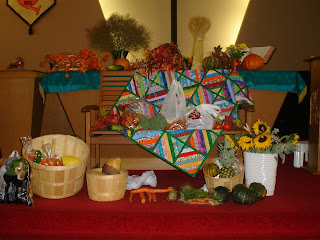
Our 2017 Thanksgiving Display 
The Scripture Readings this week are:
  • Deuteronomy 8:7-18
  • 2 Corinthians 9:6-15
    2013


The Sermon title is Remember! Be Thankful! Be Generous! 


Early Thoughts:
What is Thanksgiving Day for? A big meal? A long weekend? In NW Ontario the 2nd Saturday of October marked the beginning of moose season so a three day hunting excursion was on some minds. Or maybe is it a time to stop and reflect on life. Maybe that reflection will lead us to gratitude. Maybe that gratitude will lead us to be more generous.

The Revised Common Lectionary is a 3 year cycle. In 2 of those three years the suggested reading from the Jewish Scriptures comes from Deuteronomy. And both of those passages are a recapping of what God has done for God's people. Apparently remembering is a key part of being thankful. Apparently reminding ourselves of gifts given is a key part of being thankful for those gifts. And thinking about it, that makes a whole lot of sense. So the first step in our Thanks-giving is to Remember.

2012

The next step, logically enough, is to Be Thankful. Once we have recognized what gifts we have in our lives we have to choose to be thankful for them. We could choose to see them as entitlements rather than gifts. We could choose to say these are things that are owed to us, or things that are our right to have. But maybe that is both unrealistic and unhelpful. If we see our lives as gifts. If we see those things that make our life full and abundant as gifts then I believe we will be happier, we will be more grateful (which in and of itself changes how we view the world), we will be less likely to lament our perceived lack or scarcity, we will see the abundance that is a part of our lives. And then we will be able to give thanks.

Some people might say that the cycle ends there.  we remember, we recognize our gifts, and we give thanks. I disagree. As I consider the words and teachings of Scripture, as I consider everything I have learned about the life of faith I think there is a next step. As Children of God we are blessed, we are given gifts, we are called to be thankful people. As Children of God we are called to respond to God's gifts. We are called and challenged to Be Generous. This, I think, is the natural culmination of our Thanksgiving cycle. When we see the world as a place filled with gifts and abundance, when our hearts are thanks-filled, when we are singing praises to God for what God has done, how can we help but be generous with the world around us? And so we share with the world those things that we have been given. It is my belief that when we do that we actually have a better life. Gratitude and generosity change how we see and experience the world.

And all that is great. It is a message that could (and has) been preached on many a Thanksgiving Sunday. But this year feels different. This year there are many voices out there pointing out the list of things not to be thankful for. This year there may be more people than usual questioning what we have to be thankful for. Then again, there are some of those voices every year.

So what do you pause to remember this year? What gifts have you been given this year? Why do you say thank-you to God in the midst of the chaos that has been 2020? How are you, how can you continue to be, generous?

Blessed Thanksgiving my friends.
--Gord